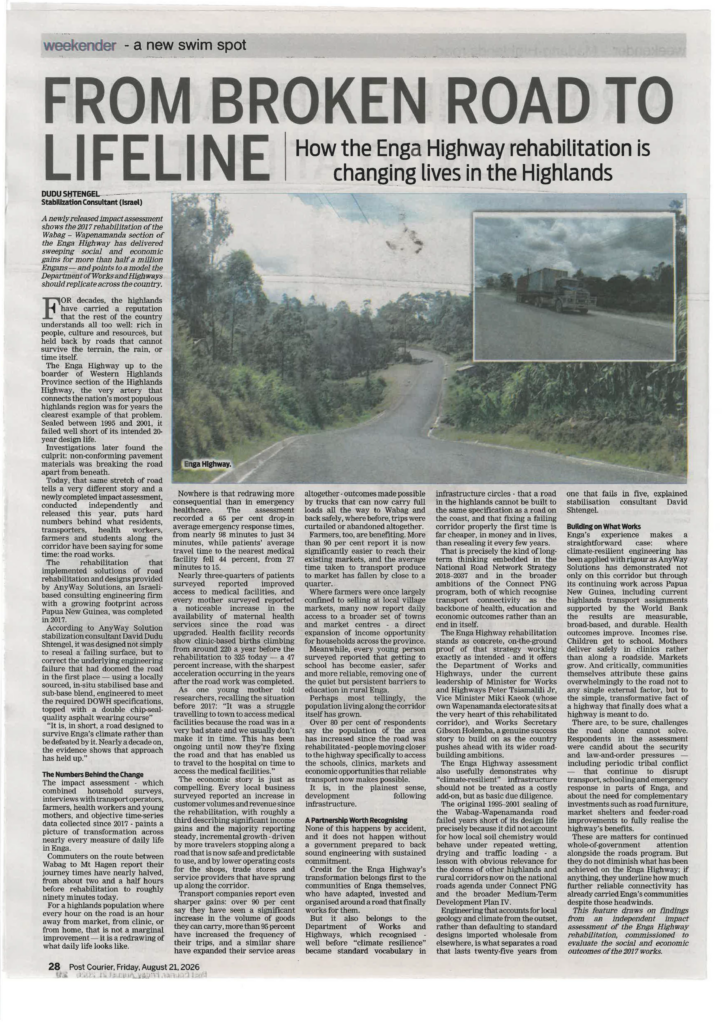
From a Failing Road to a Lifeline
The article, featured in the Post-Courier, looks at the results of an independent impact assessment of the Enga Highway rehabilitation completed in 2017. The assessment draws on household surveys, interviews with transport operators, farmers, health workers and young mothers, as well as time-series data collected since the rehabilitation.
The findings point to significant social and economic improvements along the corridor, demonstrating how a well-engineered, durable road can become much more than a transport link—it can serve as a foundation for broader community development.
The Wabag–Wapenamanda section had originally been sealed between 1995 and 2001 but deteriorated well before its intended 20-year design life. Investigations identified problems with the pavement materials and the way the road had been engineered for local conditions.
For the 2017 rehabilitation, AnyWay Solutions provided road rehabilitation solutions and designs, with the approach focused on addressing the underlying engineering problems rather than simply resealing the existing pavement. As Dudu Shtengel, AnyWay Solutions’ stabilization consultant, explains in the article, the solution incorporated locally sourced, in-situ-stabilized base and sub-base materials engineered to meet Department of Works and Highways specifications, together with a double chip-seal-quality asphalt wearing course.
The result was an approach designed specifically for the terrain, climate and conditions of the Enga Highlands.
Measurable Benefits for Communities
According to the impact assessment, the improvements extend across transportation, healthcare, agriculture, education and local economic activity.
Among the reported findings:
Together, these findings illustrate the broader development effects that can follow when reliable transportation infrastructure is designed to withstand local environmental and climatic conditions.
A Model for Resilient Infrastructure
The Enga Highway experience provides an example of how climate-resilient engineering, appropriate materials and data-informed design can contribute to lasting infrastructure outcomes.
The road has helped reduce travel times, improve access to healthcare and education, expand market opportunities and support local businesses and transport operators. At the same time, the assessment acknowledges that roads cannot address every challenge facing communities. Security concerns, tribal conflict and the need for complementary infrastructure such as feeder roads, market facilities and road furniture remain important considerations.
For AnyWay Solutions, the Enga Highway rehabilitation represents the value of applying engineering solutions that are adapted to the conditions on the ground.
As Papua New Guinea continues to expand and improve its road network, the experience of the Enga Highway offers an important lesson: resilient infrastructure begins with understanding the local environment and designing accordingly.
Read the article clipping below, originally published in the Post-Courier on August 21, 2026, to learn more about the Enga Highway rehabilitation and its impact on communities across the Highlands.