AnyWay and De La Salle University kick-off partnership with slope stability analysis and design workshop 

AnyWay and De La Salle University kick-off partnership with slope stability analysis and design workshop

The Philippines faces significant climate risks, including frequent typhoons, rising sea levels, and extreme weather patterns, making climate resiliency crucial for safeguarding communities and infrastructure. With its unique geographic location, the country is particularly vulnerable to the impacts of climate change, which threatens livelihoods and economic stability. Strengthening climate resilience is not only about building stronger infrastructure but also about educating the next generation of engineers and leaders to develop sustainable solutions. By prioritizing climate education and capacity building, we can empower local communities to gain the knowledge and tools needed to effectively mitigate risks and adapt to an ever-changing environment.
Capacity building plays a pivotal role in driving change. This initiative isn’t just about infrastructure; it’s about empowering local talent to address pressing challenges head-on. By integrating climate resilience into our projects, we’re not only advancing towards a more sustainable future but also contributing to the achievement of UN Sustainable Development Goals.
 
Knowledge Sharing to Empower the Next Generation 

Earlier this year, AnyWay and De La Salle University (DLSU) – Gokonwei College of Engineering partnered to exchange knowledge and collaborate on climate-adaptive transportation infrastructure over the next five years. The Memorandum of Agreement (MOA) that was signed, aims to establish knowledge exchange and collaboration programs on climate-resilient transportation infrastructure that benefit both parties over the next five years. The MOA provides a framework for us to collectively understand, collaborate, and discuss specific programs to:  

  • Identify opportunities for the exchange of faculty and research staff  
  • Identify other areas of possible research interest and collaboration  
  • Make faculty and students aware of the educational resources offered 

Realizing the benefits of the partnership 

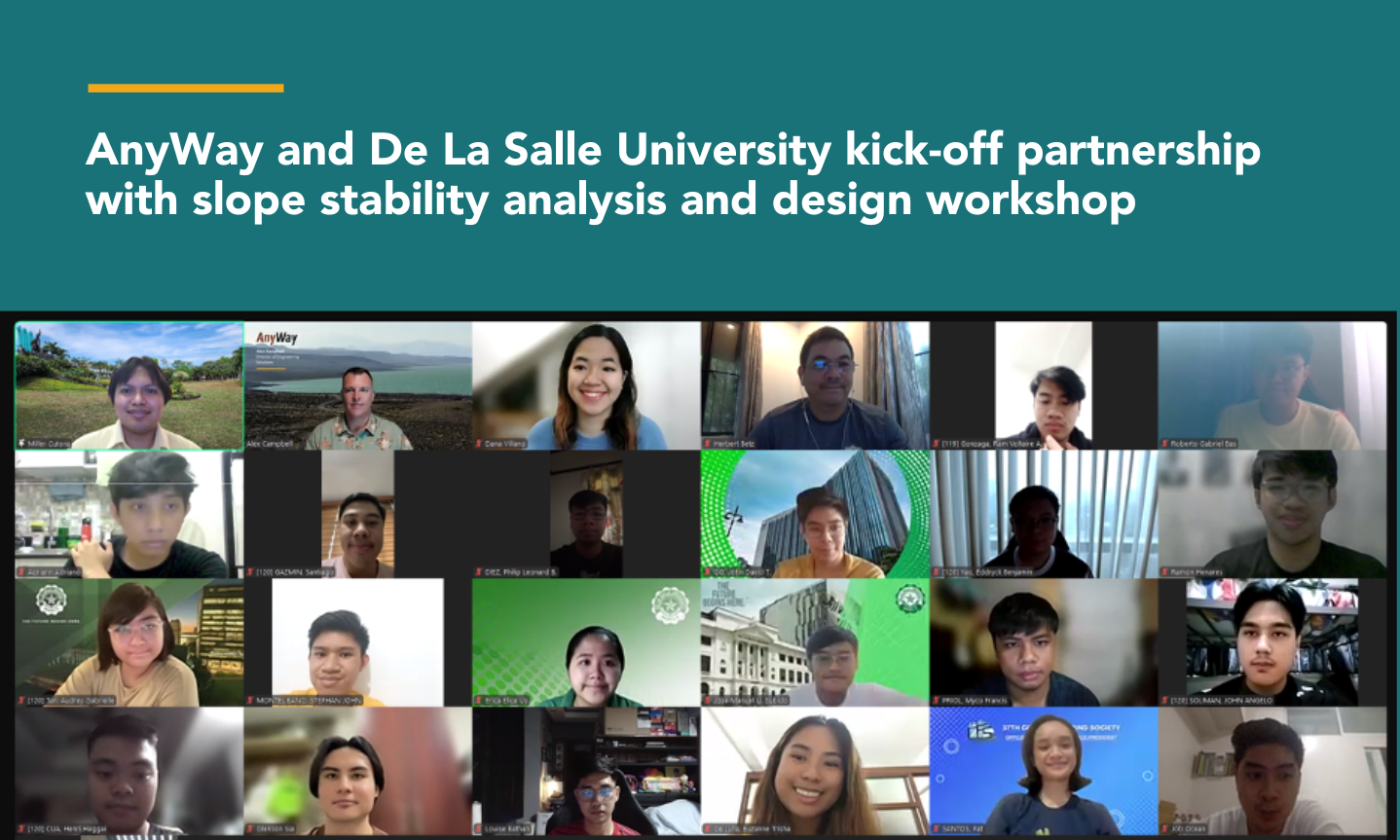
As part of implementing the program associated with the MOA, AnyWay led a workshop for the engineering students at DLSU  on slope stability, analysis, and design provided by AnyWay’s Director of engineering Solutions, Alex Campbell. The workshop was facilitated virtually from Canada to students at DLSU Gokongwei College of Engineering.  

The course emphasized the importance of understanding and analyzing slope stability to prevent landslides and ensure infrastructure safety, particularly regarding changing climate events in the region. AnyWay shared experience and lessons learned in implementing pavement engineering and climate resiliency for other projects. The workshop participants discussed the impact of changing climate on infrastructure and the need for engineers to adapt and come up with solutions. The workshop also covered slope stability and infrastructure design options and slope stabilization techniques including risk assessment, management options, and protection measures. The program will continue throughout the school year to enhance the students’ knowledge on various aspects of climate resiliency for transport infrastructure, including pavement design, pavement rehabilitation, low-volume roads engineering and rehabilitation and upgrading of road pavement structures through implementing techniques and technologies of soil stabilization to develop graduate research projects. A mentorship program will also be established to continue research into these topics.  

Knowledge sharing to enable resiliency for the next generation 

By building local capabilities and introducing cutting-edge technologies to the next wave of engineers, this partnership is poised to play a pivotal role in crafting a sustainable transportation network for the Philippines that will serve future generations well. Such partnerships are instrumental in transferring knowledge and expertise to those who will continue to develop and maintain the nation’s transportation infrastructure, while also fostering research and the adoption of innovative technologies to climate resilience.  

More information on AnyWay and De La Salle University’s partnership can be found here.
DLSU Workshop Article

Meet Solomon Nigusie – An energetic Project Coordinator

Meet Solomon Nigussie - 
An energetic project coordinator

Solomon Nigusie is a Project Coordinator at AnyWay Solutions. In his position he supervises, trains and coordinates all aspects on the rehabilitation and upgrading projects AnyWay is involved in Papua New Guinea (PNG) and elsewhere.Back in 2008, while working as a young Project Manager at the Addis Ababa City Roads Authority (AACRA) in Ethiopia, he was assigned to work on the same projects AnyWay was involved in with AACRA. There, he learned about AnyWay from the perspective of the client. Working closely with the team in Ethiopia created the opportunity for Solomon to join the company, and with the blessing of his bosses at AACRA, Solomon joined the AnyWay team in 2011. His first project at AnyWay, the Enga Highway, was in the Highlands of  Papua New Guinea. From there, the projects in the region took off and the team now has hundreds of kilometres of roads under their belt, with Solomon eager to introduce new team members to the area he’s grown so familiar with over the years.  
Being someone who enjoys a challenge, he brings problem solving to the job and believes it is most important to be open and transparent in communication when working together with colleagues and contractors. He prides himself on being fair and respectful to contractors he supervises as well as to colleague engineers no matter size or origin.   

Reflecting on one of his favourite memories with AnyWay over the past 13 years, Solomon says he will never forget the day that  AnyWay donated medical equipment to the Enga provincial government. “That was the day AnyWay proved that we are not only a partner to the Department of Works, but a true part of the community,” he says.  
Solomon is passionate about self-improvement. He enjoys learning new things and improving the skills he has. He is a very social person who is happiest when spending time with friends and family and thrives having people around him. It is important to him to share both good and bad times with others and believes meeting new people, especially from different backgrounds and cultures, expands your knowledge and life experiences.  

In the near future, Solomon plans to dive deeper into climate change’s affects and how his work can support communities to become more resilient. As climate change forces the transport infrastructure industry to explore new ways of working, he is ready to learn, and proactively adopt new approaches to design and implementation. He is enthusiastic about AnyWay’s connected and trusting team to help chart a course and embark together on this challenge.

CARIBBEAN COMMUNITY OF PRACTICE

CARIBBEAN CLIMATE RESILIENCY COMMUNITY OF PRACTICE - Roundtable 3

Solutions to management of pavement assets in the Caribbean

Once again, the Caribbean Climate Resiliency Roundtable webinar, where like-minded professionals and transport officials involved in the Caribbean communities collaborated on climate resiliency issues and solutions and shared and learned diverse knowledge for the region’s benefit.

Representatives from various island countries provided insights into current solutions for others to learn from. Participants appreciated that there are similarities across the Caribbean and that there is room for greater collaboration.

There is no replacement for knowledge share and experience, which the panellists well demonstrated: Dr. Lior Asaf, Water Resources Consulting, Konsta Mikael Sirvio SirWay Ltd., Asset Management for St. Vincent and the Grenadines, Laurence Bridgmohan BSc, MSc (UWI), REng (BOETT), MAPETT, PMP Beyond Engineering Limited, moderated by Zeevik Halber, CEO at AnyWay Solutions and hosted by Magid Elabyad, IRF Senior Vice President.

Key discussion topics:

Each speaker will presented their topic and key issues regarding pavement assets and resiliency needs.

  • What are the challenges related to road asset management
  • What areas are vulnerable to climate risks, including hurricanes and flash flooding causing landslides and rockfalls?
  • Where is there room for improvement or areas for regional collaboration?
The Caribbean Climate Resiliency Community of Practice Round Table Series was created to engage with the Caribbean Region as a platform to help prosper knowledge sharing and create resilient pavement infrastructure. 
 
If you missed the event, you can now watch it on demand: CLICK HERE

BRINGING TOGETHER INDUSTRY LEADERS IN MANILA, PHILIPPINES TO DISCUSS CLIMATE-RESILIENT TRANSPORT INFRASTRUCTURE

ANYWAY SOLUTIONS BRINGS TOGETHER INDUSTRY LEADERS IN MANILA, PHILIPPINES TO DISCUSS CLIMATE-RESILIENT TRANSPORT INFRASTRUCTURE

In response to the urgent need for climate action in the Philippines, AnyWay Solutions Ltd. (AnyWay) held a full-day symposium to discuss climate-resilient transport infrastructure challenges and solutions.

The Symposium was held on Tuesday, April 17th, at the prestigious Mind Museum, where 180 delegates from government, policymakers, engineers, and contractors gathered to listen to and participate in a discussion on addressing the Philippines’ transport needs. Knowledge was exchanged on current practices and practical solutions to help strengthen infrastructure and the overall economy (i.e. technology solutions, including satellite technology and the role of AI) and opportunities to integrate climate-resilient solutions into transport infrastructure projects.

Esteemed guest speakers such as Secretary Borje from the Climate Change Commission (CCC), Prof. Mikail Chester from Arizona State University (ASU), Prof. Michelle Rubido Palumbarit- UN CIFAL (UNITAR), and Department of Works and Highways (DPWH), Secretary Bonoan by Assistant Secretary Constante Llanes, to name a few, graced the stage. Everyone was aligned with common goals to share knowledge and encourage action for a better climate-resilient future that supports progression towards the UN’s Sustainable Development Goals (SDG).

The event was moderated by Philippines News Anchor Mai Rodriguez, and the speakers were rounded out by multiple AnyWay Solutions subject matter experts. Alex Campbell, Director of Engineering Solutions, and Zeevik Halber, AnyWays CEO, introduced a holistic approach to climate-resilient transport solutions, including transport design, pavement engineering, asset management, satellite technologies and the future of AI in transport infrastructure engineering.

With transportation networks serving as vital lifelines for communities, the symposium achieved its goal of raising awareness and mobilizing resources to bolster the resilience of these essential systems and protect the economies by reducing disruption to industries and people’s livelihoods. Delegates left with a renewed sense of responsibility and increased knowledge to address the critical issue of climate change and its impact on transportation systems across vulnerable regions of the Philippines.

“We are at a critical juncture in addressing the impacts of climate change on transport infrastructure,” said Zeevik Halber, CEO at AnyWay Solutions. By bringing together leaders from all these groups to a one-day symposium, AnyWay demonstrated its holistic approach to climate resiliency beyond mere engineering. Policy making, sharing advanced technologies and techniques, capacity building, and broader awareness are all necessary elements critical to creating climate resiliency. Together, we can make a difference!”

About AnyWay Solutions
AnyWay, has been at the forefront of providing climate-resilient solutions to the global transport infrastructure industry for over two decades. As specialists in climate resiliency for transportation infrastructure, we take a holistic approach to providing engineering designs and solutions for our clients, offering services, technologies and techniques beyond conventional engineering. Our commitment to quality in the highly specialized transportation infrastructure sector is what sets us apart. Our solutions help our clients build infrastructure resilient to climate events, allowing communities to adapt and respond to changes – infrastructure that withstands climate impacts and is known for quality and durability. AnyWay is a member of the Canadian Metrontario Group of Companies, founded in 1946.

For media inquiries, please contact:

Keren Moshkoviz
Director of Strategic Planning 
AnyWay Solutions
kmoshkoviz@anywaysolutions.com

T: +972.3.647.3506
C: +972.54.818.2398

Introducing AnyWay’s PathWay

Introducing AnyWay’s PathWay – A Low Carbon Emission Concrete Solution

Concrete, the second most widely used material on Earth after water, has a significant environmental impact. The production of Portland cement, a key component of concrete, is responsible for about 8% of global carbon emissions. In the face of the urgent challenge, achieving carbon neutrality, or net-zero carbon emissions, has become a crucial goal in the global fight against climate change.

With a global commitment to reducing GHGs and the pressure on the cement and traditional concrete industry to reduce carbon emissions, a roadmap to achieve carbon neutrality by 2050 has been established. To achieve this goal, the industry looks at the complete value chain of concrete production. This includes the need to produce low-carbon concrete mixes, optimize designs for the lowest life cycle emissions, increase the use of alternative fuels, use renewable energy in cement production, and introduce new cement mixes.

AnyWay Solutions is thrilled to announce a new patent for our product PathWay, a low-carbon emission mix optimization approach concrete designed for rigid walkways and paths with a cumulative impact on embodied carbon that is significant.

Unlike previous approaches to reducing concrete’s carbon emissions, primarily focused on reducing Portland cement within the mix, our patented invention takes an entirely different route. We’ve not only changed the ingredients in the mix, aggregates, and binder but also reduced elements of its application process, further contributing to the overall reduction of its carbon footprint. This unique approach sets PathWay apart, offering a substantially reduced carbon footprint compared to traditional concrete, making it a sustainable choice for construction projects.

“As a company, we continuously look at ways to contribute to the Sustainable Development Goals (SDGs) through a comprehensive approach to enhancing climate resiliency for transport infrastructure, including developing unique patented technologies and solutions. PathWay is our way of reducing carbon emissions globally and significantly contributing to the climate action goal (SDG 13). We’ve developed a solution for rigid walkways that significantly reduces carbon emissions and minimizes the environmental impact of construction. By utilizing recycled materials and eliminating the need for certain traditional construction components, we’re making a positive difference for the environment.” Zeevik Halber, AnyWay CEO.

Greenhouse gas emissions will continue to increase without critical steps to shift economies towards carbon neutrality. Anyway Solutions is expanding its climate action in the transport infrastructure industry to positively impact our world through our unique approach and materials.

CARIBBEAN CLIMATE RESILIENCY COMMUNITY OF PRACTICE – Roundtable 2

CARIBBEAN CLIMATE RESILIENCY COMMUNITY OF PRACTICE - Roundtable 2

Real Problems, Real Solutions for Climate Resilient Transport Infrastructure

the Caribbean Climate Resiliency Roundtable webinar, where like-minded professionals and transport officials involved in the Caribbean communities collaborate on climate resiliency issues and solutions and share and learn with a robust group with diverse knowledge for the region’s benefit.

Building off what we heard at the 2023 Caribbean Congress in the Bahamas and continuing our initial discussions in November to advance implementing solutions and policies for the greater region. In our second roundtable, representatives from various island countries will provide insights into current solutions for others to learn from. Participants can appreciate that there are similarities across the Caribbean and that there is room for greater collaboration across the region.

Key discussion goals:
Each speaker presented their island/project’s key issues regarding vulnerability, risks and resiliency needs.

  • What gaps do they have in approaching climate resiliency (e.g. data, buy-in, funding, capacity, etc.)
  • What are some of the solutions they are considering or have applied?
  • Where is there room for improvement or areas for regional collaboration?

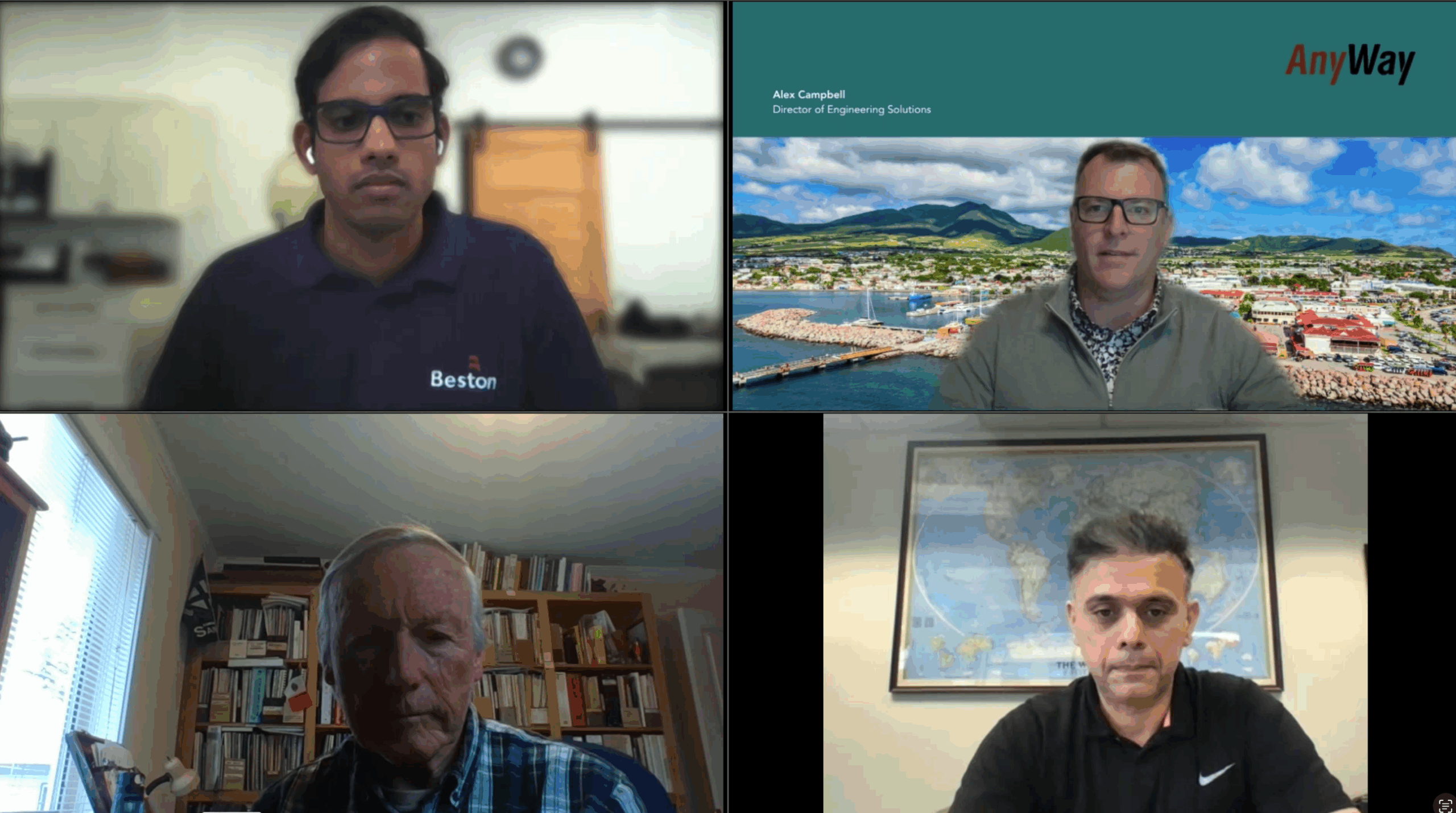
There is no replacement for knowledge share and experience, and that was well demonstrated by the panellists: Keeshan Ramkissoon, Associate Director – Civil Engineer, Beston (Trinidad & Tobago)Shinella Johnson, Manager, Engineering Design, Ministry of Public Works (Guyana), Gordon Keller, Geotechnical Engineer, moderated by Alex Campbell, Director of Engineering Solutions at AnyWay Solutions and hosted by Magid Elabyad, IRF Senior Vice President.

The Caribbean Climate Resiliency Community of Practice Round Table Series was created to engage with the Caribbean Region as a platform to help prosper knowledge sharing and create resilient pavement infrastructure. 

Join us quarterly! The next event will be June 2024

For more than two decades, AnyWay has been a global expert in providing climate-resilient solutions to the global transport infrastructure industry. AnyWay is a member of the Canadian Metrontario Group of Companies, with over 75 years of business experience. Its total commitment to quality is what has fueled AnyWay’s success.

Workshop on Climate Resiliency for Road Transport

Workshop on Climate Resiliency for Road Transport

In an effort to support developing nations with knowledge sharing on the importance of climate resiliency on transport infrastructure, we are pleased to offer a three-hour workshop for transport infrastructure engineers.

This workshop is designed to provide an introduction to the risks of climate change and how they impact transport infrastructure. Participants will be introduced to the principles of climate change, the vulnerability and risks associated wit a transport infrastructure network, and best-practice approaches to integrate into transport infrastructure projects to enhance their resiliency to climate change effects. The workshop will introduce drainage and water management approaches that are aimed at increasing he resiliency to an uncertain climate future. Tehniques that will be addressed include infrastructure technology (InfraTech) that can be used to capture pertinent data, proper drainage and catchment area analysis, pavement design principles, and approaches to produce more robust pavement assets. Ask extensive set of resources will be reviewed where participants can turn to access more information and learn about how best to manage transport infrastructure assets as we navigate an uncertain climate future. 

Course themes:

  1. Introduction to climate change and climate resiliency of transport infrastructure. 
  2. Climate vulnerability and risk assessments. 
  3. InfraTech and data acquisition and interpretation
  4. Best-practices for climate resiliency of transport infrastructure. 
  5. How to get more information. 
  6. Conclusions and questions. 

Course outcomes:

  • Define the vulnerability and risks of transport infrastructure assets, including bridges, culverts, drainage elements, and pavements. 
  • Understand pavement design parameters and their relevance to creating climate resilient designs. 
  •  Develop an understanding of how InfraTech can assist with the decision making process. 
  • Develop a set of road transport interventions that can be used to safeguard critical infrastructure from an uncertain climate future. 
  • Understand the need for forward-looking designs. 
  • Understand how to get more information related to the subject and what is needed to better estimate the resiliency of transport infrastructure networks/projects. 

Schedule a workshop

Reach out if you would like to schedule an online workshop for your department hosted by AnyWay’s Alex Campbell. 

Download the workshop brochure. 


Climate workshop thumbnail

AnyWay and De La Salle University Enter Partnership to Enhance Climate-Resilient Transportation

AnyWay and De La Salle University Partner to Enhance Climate Resilient Transportation

Memorandum of agreement signed between De La Salle University and AnyWay Solutions

We have partnered with De La Salle University (DLSU) – Gokongwei College of Engineering to exchange knowledge, and collaborate on climate-adaptive transportation infrastructure over the next five years. 

By signing a Memorandum of Agreement (MOA), we have officially partnered with De La Salle University (DLSU). The partnership aims to establish knowledge exchange and collaboration programs on climate-resilient transportation infrastructure that benefit both parties over the next five years. The MOA provides a framework for us to collectively understand, collaborate, and discuss specific programs to:  

– Identify opportunities for the exchange of faculty and research staff 

– Identify other areas of possible research interest and collaboration 

– Make faculty and students aware of the educational resources offered


For the first few years, we will work together with DLSU to educate the students on various aspects of climate resiliency for transport infrastructure, including pavement design, pavement rehabilitation, low-volume roads engineering and rehabilitation and upgrading of road pavement structures through implementing techniques and technologies of soil stabilization to develop graduate research projects. A mentorship program will also be established to continue research into these topics.  

At COP28, the Philippines was highlighted as one of the nations most susceptible to the impacts of climate change. Recognizing the urgency to bolster the country’s infrastructure against these effects, DLSU sought a partnership with AnyWay Solutions, based on our 20-year track record of delivering climate-resilient transportation solutions to developing countries.

This collaboration will leverage our expertise to engage with academia and global experts in a concerted effort to fortify the nation’s resilience. By building local capabilities and introducing cutting-edge technologies to the next wave of engineers, this partnership is poised to play a pivotal role in crafting a sustainable transportation network for the Philippines that will serve future generations well. Such partnerships are instrumental in transferring knowledge and expertise to those who will continue to develop and maintain the nation’s transportation infrastructure, while also fostering research and the adoption of innovative technologies to climate resilience. 

Following the signed MOA, Zeevik Halber, AnyWay CEO was invited to appear on Business Outlook on ABS-CBN News in the Philippines. In the interview, he shares more details on the partnership and the projects and solutions that will help the Philippines strengthen their transportation infrastructure and enable it to become more resilient in the wake of climate change.

See the full interview below beginning at 10:00.

As we look to the future of our industry workforce, programs like the ones we are embarking on with the DLSU will prepare the next generation of engineers for the challenges ahead of them, specifically to benefit the Philippines and build local capacity.”  –Zeevik HalberAnyWay CEO.

Leveraging New Technology for Sustainable Infrastructure

Leveraging New Technology for Sustainable Infrastructure

Insights from TRB2024

During my time in Washington, DC, while attending the highly anticipated Transportation Research Board Annual Meeting, I had a few Ah-ha moments. As the world is moving towards everything digital, it is surprising that I learned Infrastructure is the second-least digitally transformed sector of the economy. It’s even more surprising knowing that Infrastructure is responsible for 79% of all greenhouse gas emissions.

When we pair infrastructure with technological solutions, we can reduce GHG emissions significantly. So why aren’t we moving the needle faster? Technology is essential to infrastructure achieving net zero and sustainable development goals (SDGs). Still, much infrastructure operates almost exactly as it did 50 or even 100 years ago because of systemic barriers to technology adoption.

Where can we start?

  1. Introducing existing and new technology-based solutions to the infrastructure sector can help reduce the environmental impacts of roads and improve road safety by improving the quality, cost-effectiveness, and affordability of road design, construction, operation, and maintenance.
  2. Technology can also facilitate adapting our infrastructure to make it more resilient to a changing climate using AI-enabled decision support tools, AI analyzing road conditions, Asset design and monitoring by satellite imagery and much more.

In developing countries, the positive impact can be even greater as they are cost-sensitive and most vulnerable to climatic events. Making digital tools accessible and practical to address the unique challenges of developing countries will greatly impact people’s lives.

To summarize, we need to make bigger efforts to support emerging technologies, which can be applied at any point in the infrastructure lifecycle to achieve one or more of the impacts listed above. To overcome the barriers to implementing Tech in a practical way in the infrastructure sector, we need to work together to reveal the full strength of tech solutions in delivering cost-effective, fast and data-driven solutions.

Research and development of new transportation solutions are greatly needed to continue improving our world, and we can only achieve greatness together. Platforms like TRB allow professionals from all walks of life to share experiences, knowledge and collaborate for the future of our transportation networks and proactively face challenges.  Thank you to the organizers of TRB for continuing to foster this amazing group of industry professionals, from YPs to the most seasoned engineers. I look forward to learning more throughout the year, and we will see you in January 2025 once again.

Picture of Keren Moshkoviz

Keren Moshkoviz

Director of Strategic Planning
AnyWay Solutions

CARIBBEAN CLIMATE RESILIENCY COMMUNITY OF PRACTICE

CARIBBEAN CLIMATE RESILIENCY COMMUNITY OF PRACTICE

Roundtable #1:

Roadmap to Climate Resilient Transport Infrastructure – Introducing the Community of Practice

AnyWay Solutions kicked off the inaugural Caribbean Climate Resiliency Roundtable with the International Road Federation (IRF). A group of professionals and transport officials from Caribbean communities came together for the first discussion on climate resiliency. The participants collaborated on identifying potential solutions and shared their knowledge and insights for the benefit of the region. This is the first of a series of discussions aimed at addressing the challenges posed by climate change in the Caribbean.


The Caribbean is one of the most vulnerable regions to climate change and has recognized that the time for action is upon them. Roads are critical to economic prosperity, but also for social and health services and access to education. Roads are also crucial in the region for disaster relief and response, which further emphasizes the criticality of having a well-functioning pavement network. Implementing climate resiliency into pavement networks to accommodate for an uncertain climate future is complex, but there is a unified consensus amongst stakeholders that it is necessary to ensure that pavement assets are preserved as the Caribbean continues to develop. With so many moving pieces, including stakeholders, issues, problems and solutions, a need presented itself to create a forum whereby collaboration amongst like-minded professionals and stakeholders involved in ensuring the sustainability and resiliency of Caribbean transportation systems could share and learn from each other to create a unified Caribbean Road community. 


There is no replacement for knowledge share and experience, and that was well demonstrated by the panellists: William Ashby of the Caribbean Development Bank, Frederico Pedroso of The World Bank, Pablo Guerrero of IADB Bank and Mr. Mark Cummins, Senior Planning Consultant, moderated by Alex Campbell, Director of Engineering Solutions at AnyWay Solutions and hosted by Magid Elabyad, IRF Senior Vice President.


Highlights:

  • How much resiliency can we afford
  • The time to invest is now and funding is available
  • Capacity restraints and building in the region

The Caribbean Climate Resiliency Community of Practice Round Table Series was created to engage with the Caribbean Region as a platform to help prosper knowledge sharing and create resilient pavement infrastructure. 

Join us quarterly! The next event will be January/February 2024